
| HISTORICAL SUMMARY The Great Camp Era Sekon's history goes back to the era of Adirondack great camps in the late 1800s. Isaac Newton Seligman, a New York investor and at the time one of the wealthiest men in the country, developed his "Fish Rock Camp" , as the Sekon property was first called. It is just north of Jules Bache's Wenona, which was built a few years later. Joseph L. Seligman, Jr., the only grandson of Isaac N. Seligman, stated in letters to a Sekon resident in 1982 and 1998 that the original camp was constructed by local craftsmen in the late 1870s or early 1880s. However, subsequent research shows that construction began in the 1890s. There were no roads around the lake at that time, so the Seligman's reached their camp by taking a boat from the north end, the closest spot to a rail spur. The entire original camp , except for the Hill house, burned to the ground in 1904, accounting for the camp being the only one on the lake surrounded by a lawn instead of trees, as it remains today. Most of the Sekon buildings which we know today date from the reconstruction of the camp completed in 1905,so they are more than 100 years old. Joseph Seligman, born in 1913, spent most of the summers of his youth at his grandparents' Fish Rock Camp. He recalls "a fabulous camp" with 32 master bedrooms, lights by acetylene, a boathouse, and four living houses, which included the Hill House, the main house, the dining hall and the winter house -- and a servant staff of 30 to 50. "During its heyday in the late '20s and '30s, Fish Rock Camp would accommodate about 30 guests, and when we had more my mother would take her friends on a camping trip or I would take mine. We'd go in canoes to Fish Creek Pond, Follensby, or other places whose names I've forgotten. By 1940 many of our favorite camping places had become public campgrounds, and I assume they still are," Joseph Seligman wrote. The property which was to become Sekon also included another great camp just to the north called Calumet. Calumet was the summer home of Isaac Seligman's brother George and his sister, Mrs. Theodore (Frances) Hellman. Isaac Seligman was killed in a horseback riding accident in 1917, but his widow Guta, a daughter of Soloman Loeb, another famous family in Our Crowd, ran the camp until she became ill around 1931 or 1932. After that, Joseph Seligman's parents alternated summers using the camp with his father's sister, who had married a Lewisohn, another famous Jewish family who owned the great camp Prospect Point further north on the Upper Lake. Wrote Joseph Seligman of his Fish Rock Camp recollections: "Mostly they are of boyhood days. Tennis, water-skiing, camping and lots of people. We seldom sat at the dining room table with less than 12 or 14, and often 25 or 30. Grandma's friends were old and formal; my parents' friends did a lot of close harmony singing and drinking; my friends were mostly boarding school friends. Camp was unlike any place my friends had ever seen." The Sekon Lodge Era After the Great Camp era, Fish Rock Camp and Calumet were operated as an all-inclusive Adirondack resort under the name Sekon Lodge. Old advertisements for the resort boast of over 15 lodges "designed as Swiss chalets, many connected by enclosed corridor, and several cabins are equipped with spacious living rooms, bedrooms, private baths and open fireplaces." Daily rates per person ranged from $15 to $23 and included three meals a day of "exceptionally fine cuisine." The Sekon Auction On July 11, 1964, the Sekon buildings and surrounding land were sold at auction. Charles Vosburgh, a developer from Cortland, N.Y. , who had acquired the Sekon Lodge, subdivided the property and marketed it as small, individual parcels, a profit scheme he repeated many times in the Adirondacks on many similar properties. At a crowded auction that day, 22 cottages and buildings, 9 lake-front lots and 26 other parcels of land ranging up to 10 acres, went under the gavel. The Sekon water and septic systems, the beach , the boat docks and roads were assets held in common by the new multiple owners, a legally binding arrangement set forth in the new property deeds. The new closely packed and interdependent community required a homeowner association to govern it. Sekon Association On August 2, 1964, just days after the auction, the first meeting of the Sekon Association was held in the former guide house. Temporary officers were elected: Larry McKillip, president; Mildred Goodrich, secretary and treasurer; and board members E. Wendell Carrier, David H. Danker, Warren F. Longacker and Nolan Powell. More than 40 years later, the Sekon Association continues to operate as the homeowner association of the combined Sekon properties. The association operates under a set of bylaws adopted by the membership and occasionally amended to suit the needs of changing times. The association levies dues used to maintain roads, the boat landing, the docks, the common beach and other necessities such as insurance. Separate fees are levied among those Sekon owners whose homes are on the association's common septic system. The common water system -- which once drew water right out of the lake -- has been replaced by individual wells on each owner's property. Each year Sekon Association holds a membership meeting and on that evening organizes a steak roast and social event which routinely draws a hundred or more present and former Sekon residents. Many original Sekon auction buyers watch as their children, grandchildren and great-grandchildren gather to share food and games at a cherished spot which has become their summer home, and for many, their place of the heart. (To read the most detailed Sekon history ever compiled click on the Longacker History link in a box near the top left of this page. Follow the link to a time line of the camp history at the top of this page.) |
Camp Fishrock
History
History
Longacker History
Warren F. Longacker,
an original Sekon
auction buyer, many
years ago wrote the
most detailed history of
Sekon ever completed.
To read text only of his
"A History of Sekon
and its Surroundings,"
click here.
Warren F. Longacker,
an original Sekon
auction buyer, many
years ago wrote the
most detailed history of
Sekon ever completed.
To read text only of his
"A History of Sekon
and its Surroundings,"
click here.
 |  |  |
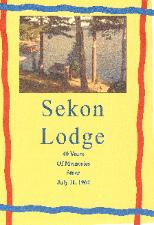
Scanned copy of
Diane Garlock's Sekon
Lodge, 40 Years of
Memories Since July,
1964 is at this link.
Diane Garlock's Sekon
Lodge, 40 Years of
Memories Since July,
1964 is at this link.
Scanned copy of the
complete Longacker
history.
complete Longacker
history.
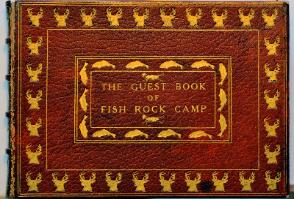
A complete digital copy of the Fish Rock Camp guest
book is now available on this site. With only a few
exceptions, all the fine illustrations in the guest book
are the work of Isaac N. Seligman, Fish Rock's owner.
He produced them from 1905 to 1915. They are an
exceptional and unique pictorial record of the camp.
The digital copy of the guest book here is made
possible through the generosity of Seligman family
descendants.
View a Digital Copy of the Fish Rock guest book.